Energy calculator

This is how much you can save on your heating bills with new windows

Up to 30% of your heat flies straight out of your windows.
Work out how much you could save on your heating bills by swapping your draughty old windows for energy-efficient ones.

Calculate your savings in 1 minute ↓
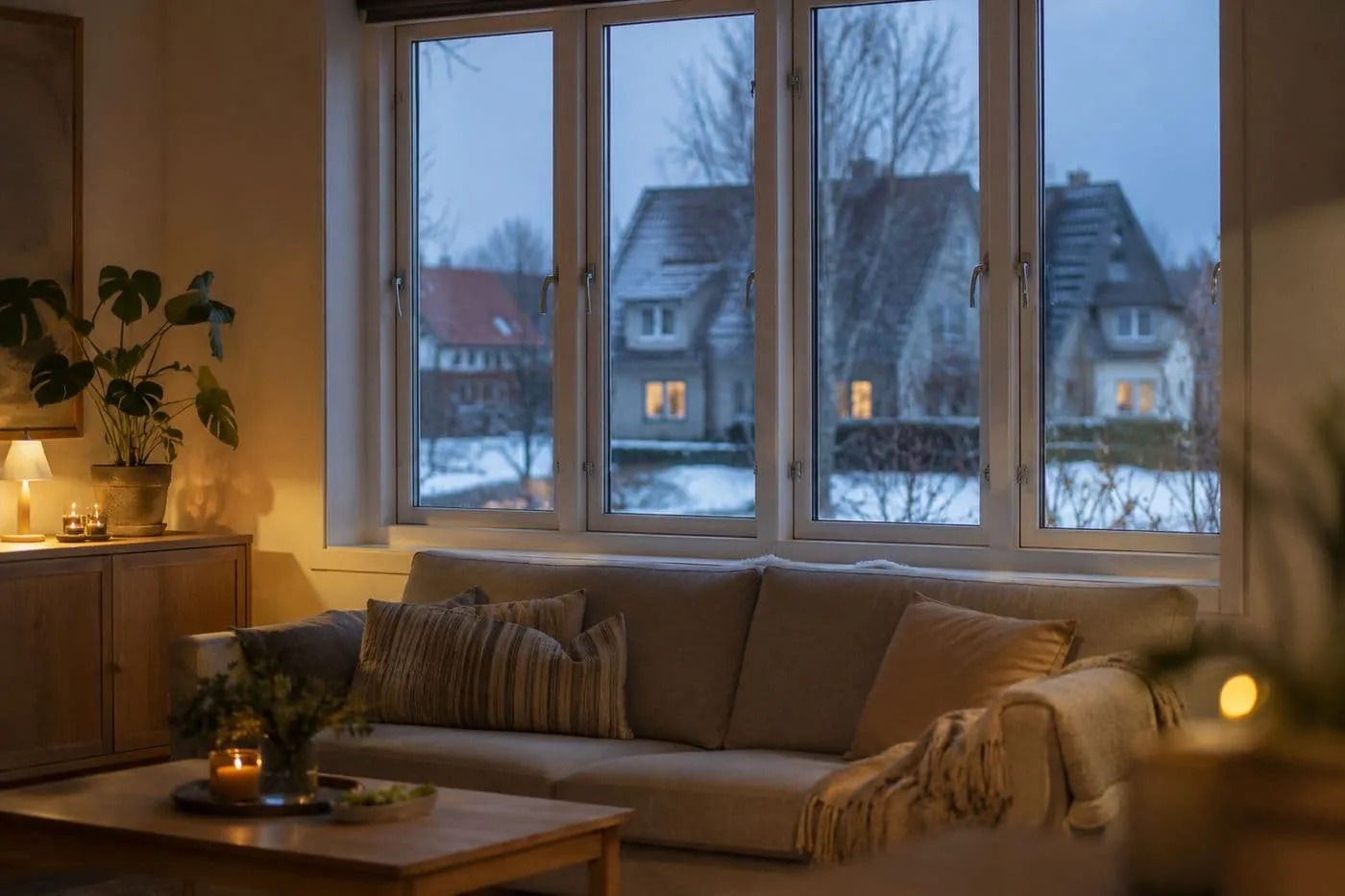
Warm, bright living room behind new energy-efficient windows on a winter evening

Calculate your savings

Enter your home's size, your heat source and the age of your windows – and you'll get your estimated annual savings straight away.

3 good reasons to get new windows

Save DKK 7,200 a year on your heating bill

If you live in an average detached house with old windows and district heating, you could save up to DKK 7,200 a year on your heating bill. Over a 20-year period, that adds up to savings of DKK 144,000.

If your home has a more expensive heat source (electricity, gas or oil, for example), you could save up to DKK 412,000 on your heating bills. And that's "just" from replacing your old, draughty windows.

Curious about your potential? Calculate your savings now.

Increase your home's value by 88%

On average, your home's value increases by 88% of what you spend when you replace old, worn-out windows with new, highly insulated ones. That means if you spend, say, DKK 150,000 on new windows, you can on average expect to recoup DKK 132,000 if you ever sell your home.

Some homeowners find they make all the money back, while others even come out ahead – with returns of up to 67% above what they spent.

Source: Realmaeglerne.dk

Enjoy a better quality of life at home

As well as being good for your wallet, new windows can also make your home a nicer place to be. The indoor climate improves, giving your home the right ventilation and warmth – which, among other things, reduces the risk of damp damage, mould and draughts.

Noise and pollution from outside are also reduced, which can improve your quality of life at home.
Find your annual heating bill savings

Based on your home's heat source and when your windows date from. The table below is based on an average Danish detached house of 154.5 m².

Heat sourceBefore 19601961 - 19711972 - 1995
District heatingDKK 7,200DKK 4,300DKK 3,900
Natural gasDKK 10,100DKK 6,000DKK 5,500
Oil boilerDKK 16,000DKK 9,800DKK 8,800
Electric radiatorDKK 20,600DKK 12,400DKK 11,200
Air-to-water heat pumpDKK 6,500DKK 3,900DKK 3,500

Please note: the result is indicative only, as every home is unique and depends on how well the property is insulated overall, beyond the windows. You should always consult an energy adviser.

Calculate the savings for your home
The energy renovation grant scheme

You can apply for a grant towards your new windows

If you're replacing your old facade windows with new energy-efficient ones, you may be able to get a grant through the government's energy renovation scheme (Energirenoveringspuljen) – on top of your heating bill savings and your tax deduction. The grant isn't automatic, though: you and your home need to meet a number of requirements before you can apply.

Among the requirements you'll need to meet:

  • Year-round home with an energy rating: the property must be your year-round home and have a valid energy rating.
  • Apply before you start: your application must be approved before the work begins – you can't apply once the windows have already been replaced.
  • CVR-registered company: the work must be carried out by a CVR-registered company (we are one), and you must not have previously received a grant for the same project.

The scheme covers, among other things, replacement of existing facade and roof windows, and in 2026 the rate is up to DKK 680 per m² of window area for private homeowners. Grants are awarded on a first-come, first-served basis for as long as funds remain. See the full conditions and current rates at SparEnergi (the Danish Energy Agency) before counting on the grant.

Get the price for your project. Book online now

Get a no-obligation quote for the supply and installation of new windows (and doors), with a free survey by our window experts.

We'd rather not waste your time, so if you're hunting for the absolute cheapest option on the market, don't book with us. What we are is the easiest tradespeople to get new windows and doors with:

  • You get quality windows/doors that last for generations (so you won't be wrangling tradespeople again in 5 years' time)
  • Your windows/doors are fitted by specialist carpenters (who turn up on time, work efficiently and tidy up after themselves)
  • You're kept up to date throughout (with a clear schedule and daily video updates from the installation)

That way you're spared the worry – and the days off work to project-manage your tradespeople. And as everyone knows, time saved is time earned. So perhaps we're the cheapest after all...

We're your experienced carpenters, specialising in windows and doors

Have new windows and doors surveyed, ordered and installed by a team of trained carpenters. We advise you based on 25+ years' experience with windows and doors.

Get a quote for your project

FAQ about energy calculations

Our calculator shows you how much you can save on your heating bills by replacing old windows with new energy-efficient ones. Read on to understand how the calculator works and how to spot an "energy-efficient" window using the energy rating scheme.

How to calculate your heating bill savings

Use our calculator at the top of the page, where you enter: 1) the size of your home, 2) your home's heat source, and 3) the age of your current windows. With these 3 details, you'll get the estimated annual heating bill savings from replacing your windows with new energy-efficient ones. The result is only indicative, as every home is unique. You should always consult an independent energy adviser.

How are my savings calculated?

The calculation is based on a method developed by the Danish Technological Institute and builds on these 3 parameters: 1) The size of your home – we ask about your home's size to estimate how large your window area is. In a Danish reference house under DS 418, the window area makes up 21.85% of the floor area. 2) Your home's heat source – we need to know the heat source so we can put a price on the "lost" heat seeping out through your windows. Current energy prices are updated regularly from Bolius.dk. 3) The age of your current windows – windows' ability to retain heat has developed over the years, and the minimum requirements have been adjusted along the way. Once we know the age of your windows, we can use the Danish Technological Institute's research to determine how good your old windows are at holding on to heat. A window's ability to retain heat is defined by a so-called "E-ref" value, calculated for a reference window measuring 1230 x 1480 mm. Based on the minimum requirements in force in each period, these E-ref values are used: 1900–1960: Eref = -303.8 kWh/m² per year. 1961–1971: Eref = -177 kWh/m² per year. 1972–1995: Eref = -158.9 kWh/m² per year. 1996–2011: Eref = -67.0 kWh/m² per year. In our calculation, we assume you're replacing your old windows with an approved energy-efficient window with an E-ref value of 15. New approved energy-efficient windows must have a value above 0 as a minimum, and can go all the way up to 30+.

What is the "e-ref" value?

The E-ref value shows how well a window performs overall at retaining heat and harnessing the sun's energy. It takes into account both the heat lost through the window and the warmth the sun can add to your home. If a window's E-ref value is positive, the window adds more heat to your home than it loses. That's good for both your heating bill and the environment. If the value is negative, the window loses more heat than it contributes, which can mean higher heating consumption. When you're choosing windows, we'll help you find ones with a good E-ref value, so you get windows that both hold on to the heat and make the most of the sun. That means a lower heating bill and a more comfortable home all year round.

Is it worth replacing my old windows?

That naturally depends on the price of the windows themselves and the cost of installing them. Get the exact price for your project with a free survey from us. Book online now, and we'll come out and give you a no-obligation quote for the supply and installation of new windows (and doors, if needed).

Book a time here

Calculate my investment in new windows

When you invest in new windows, it pays to look at your return on investment. You'll of course have the cost of buying your new windows and having them fitted. On top of that, you should factor in the following, which all help you earn the money back: The tax deduction: you can use the håndværkerfradrag, which gives you a financial contribution towards the labour cost of installing your windows. Heating bill savings: new energy-efficient windows can cut your energy consumption significantly. You save money every month and enjoy a more comfortable, draught-free indoor climate at the same time. Increased home value: energy-efficient windows can raise the value of your home, because they make it more attractive and more energy-efficient for future buyers. We'll help you put together a concrete calculation, so you can see how quickly your investment in new windows will pay for itself – both through ongoing savings and a higher property value.

Book a time here and get a no-obligation quote

What is the energy rating for windows?

The energy rating for windows helps you choose windows that improve your home's energy efficiency and reduce heat loss. The rating is divided into classes from A to F, with A being the most energy-efficient windows. Here's how the energy rating works: A: the most energy-efficient windows, with very low heat transmission and excellent insulation. Ideal if you want to make your home more energy-efficient. B and C: windows that still insulate well, but aren't quite as energy-efficient as A-rated windows. D–F: windows with lower energy efficiency – often older models – which can lead to greater heat loss and poorer insulation.

How is a window's energy rating calculated?

The energy rating gives you an assessment of a window's energy efficiency based on three key factors: U-value (heat loss): this indicates how much heat escapes through the window. The lower the U-value, the better the window insulates, which means less heat loss and a lower heating bill. G-value (solar gain): this shows how much of the sun's warmth can pass in through the window. A high G-value means the window helps warm your home using the sun's energy, which is especially useful in the colder months. Airtightness: this assesses how well the window holds on to heat and prevents draughts. An airtight window means a better indoor climate and less wasted energy. By choosing windows with a high energy rating, you can cut your energy consumption and make your home more comfortable to be in – all year round.

How do I choose the right energy-efficient window?

If you'd like to find out what energy rating a window has, we can, as your adviser, help you with all of it. We make sure the window complies with the law while also matching your wishes for energy savings and comfort. When you contact us, we look at what your home needs and which specifications will benefit you most. We guide you to the best windows for your energy-efficiency needs and make sure the rating is up to date and in line with the latest standards. That way, you get windows that deliver both warmth and value – and a lower heating bill! If you'd like to explore the market yourself, you can read more about energy-efficient windows at www.energivinduer.dk. Please note: only facade windows are covered by the energy rating scheme. Roof windows, dome rooflights, panes and secondary glazing are not included.

Who developed the energy rating scheme?

The energy rating scheme for windows was developed by the Danish Energy Agency in collaboration with the Danish window industry. The aim is to give you, as a homeowner, an easy-to-understand assessment of a window's energy efficiency, so you can quickly tell whether a window is energy efficient. The Danish Energy Agency is also behind the energy rating scheme for entire buildings, but for windows specifically, the assessment is based on standardised tests and requirements developed in collaboration with window manufacturers and the relevant trade bodies. This ensures the energy ratings are based on reliable data and take into account both insulation performance and solar heat gain.

A certificate of the window's energy efficiency

We help you make sure your new windows come with an energy-efficiency certificate. A certificate like this means the manufacturer is subject to ongoing checks, and that the energy data has been tested and approved by independent experts. As your adviser, we make sure the windows you choose meet the highest standards of energy efficiency, so you can make a confident, well-considered choice.

Energy calculator

Want to work out how much you could save?

Get your estimated annual heating bill saving in under a minute.

Calculate the savings for your home